A tabletop tripod makes sense when you want to put a small camera down, join a family photograph, or keep the same framing for a quiet project. The right choice depends as much on the table and the camera’s balance as on the weight printed on a product page.
For a flat indoor surface, start by considering the Manfrotto PIXI EVO. If your small camera needs legs you can shape around an uneven support, the JOBY GorillaPod 1K Kit offers a different approach, with a lower published load limit.
This is a research-based comparison of two exact kits, not a report of hands-on testing or a ranking of every mini tripod. Manufacturer information and the selected Amazon listings were checked on October 23, 2026; prices and offers can change.
As an Amazon Associate, this site earns from qualifying purchases. The product links below use this site’s existing affiliate tag.
What a tabletop tripod can realistically solve
You can use a short support to avoid balancing a camera on a mug, repeat a composition, or get yourself into the photograph. You still need a safe, stable surface at the right height.
For a standing group in a room without a suitable shelf or table, a full-height tripod may be the more useful purchase. A miniature tripod on the floor can leave you with an awkward upward angle and more foreground than you wanted.
It also cannot freeze children who move during the exposure. Keep a shutter speed suitable for the people in the photograph, even when the camera itself is supported.

Review: Manfrotto PIXI EVO, black MTPIXIEVO-BK
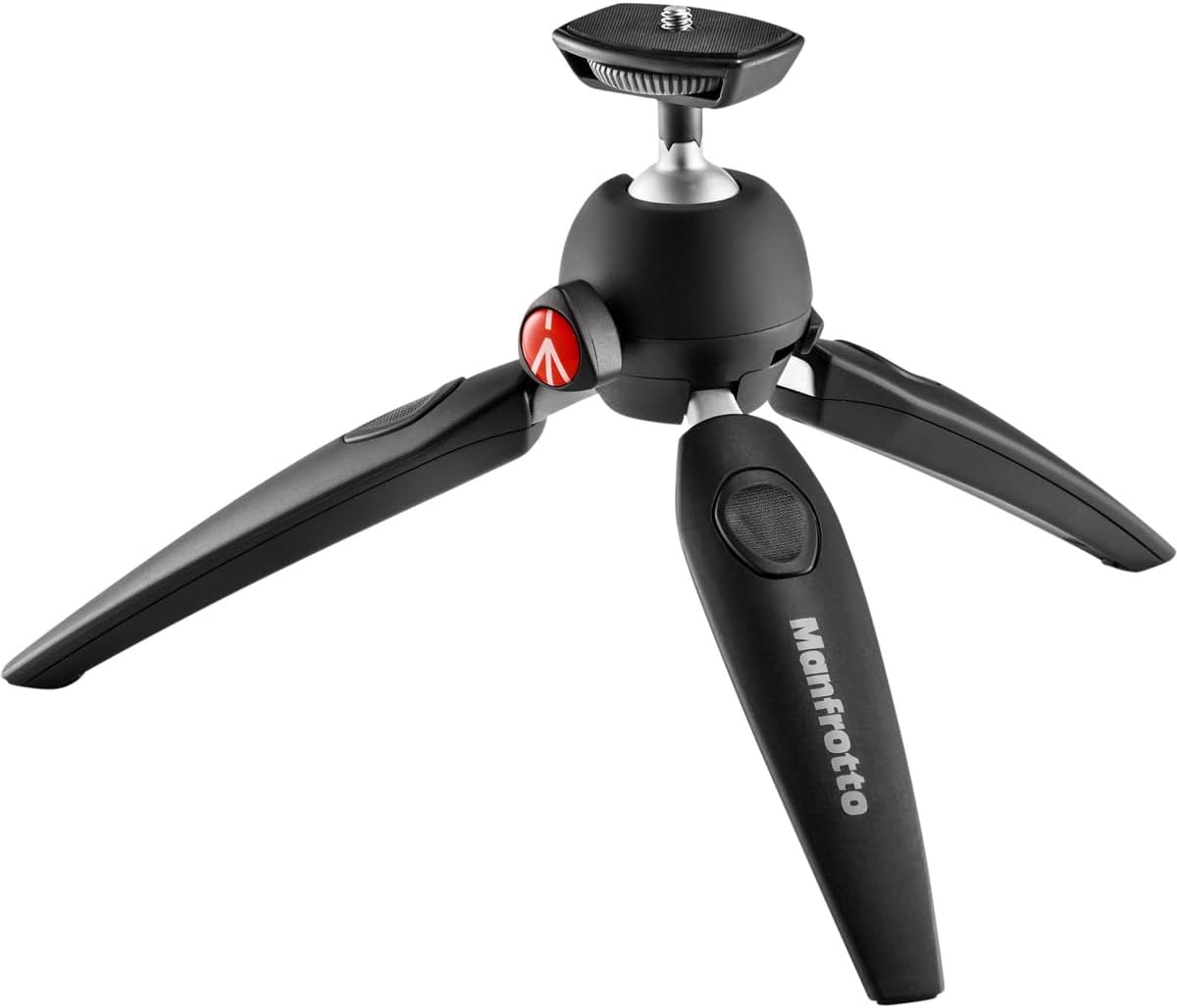
Choose the PIXI EVO when you want conventional short legs on a table and a head that lets you frame vertically. The exact black model here is MTPIXIEVO-BK, rather than the original fixed-height PIXI.
Manfrotto’s product material describes two leg-angle positions, two-section legs, and portrait orientation through a 90-degree tilt. Its published safety payload is 2.5 kg, but that figure does not promise that every long lens or off-center camera will balance safely.
The manufacturer product sheet also limits its entry-level DSLR compatibility guidance to a body of 750 g or less and a nonprofessional lens in the 18–200 mm range. Check those conditions as well as the total equipment load.
The practical appeal is straightforward setup: find a level surface, spread the legs, adjust your framing, and check the locks. If you repeatedly photograph at the same dining table, this style gives you fewer leg-shaping decisions between frames.
Your main limitation is height and placement. You must bring the tripod to a surface that already gives the camera a useful view, and the extended feet need room that a narrow ledge may not provide.
Before choosing it, measure the space you actually use and consider where your lens points when you turn the camera vertically. A camera that feels secure in landscape orientation still deserves a fresh balance check after you tilt it.
The integrated mounting arrangement also means you should not assume a separate quick-release plate comes in this kit. If you attach and remove the camera many times a day, decide whether direct screw mounting suits your routine.
Review: JOBY GorillaPod 1K Kit, JB01503-BWW

Choose the GorillaPod 1K Kit when flexible legs are useful for a genuinely small camera. The selected Black/Charcoal kit combines the jointed legs with a ball head; it is not a legs-only listing or a larger GorillaPod model.
JOBY specifies support for equipment up to 1 kg, including a removable ball head for framing. Count the lens, battery, and anything left attached to the camera when checking that limit.
The leg design gives you a way to adapt the three feet to an uneven surface. That can be handy on a broad, irregular tabletop where rigid legs would need awkward shimming.
You should still test the arrangement while holding the camera, especially after changing a leg shape or head angle. Flexible legs are a different setup method, not evidence that a questionable support becomes safe.
For a family self-portrait, keep the tripod somewhere a person can supervise and where children cannot pull it down. Avoid hanging a camera over people, putting it above a drop, or treating a narrow rail as a reliable support simply because a leg can wrap around it.
This is the less suitable option if your camera-and-lens combination already approaches or exceeds its stated limit. It also asks you to pay attention to foot placement each time, which may feel slower than a conventional base on the same flat table.
Compare the job before comparing the number
| Question | PIXI EVO | GorillaPod 1K Kit |
|---|---|---|
| Leg approach | Short conventional legs with adjustable sections and angles | Flexible jointed legs |
| Published equipment limit | 2.5 kg safety payload | 1 kg supported equipment |
| Useful starting situation | Flat table and repeatable family framing | Small camera and an uneven, broad support |
| Main planning issue | Surface height and footprint | Total kit weight and deliberate leg placement |
A larger payload number does not tell you which tripod is steadier in your particular arrangement. Lens length, camera orientation, an extended screen, and a cable pulling sideways all change how the setup behaves.
Think of the whole assembly as one object resting on three feet. Keep its weight over the supported area and stop if a foot lifts or the setup wants to rotate as you let go.

On a small screen, scroll the diagram sideways to read its labels.
Check your camera before ordering
Look for the tripod socket on the camera and confirm the mounting connection in its manual. If you want to use a phone, budget for a compatible clamp rather than assuming either camera kit includes one.
Weigh the camera with the lens and accessories you actually plan to use. A body-only specification on a manufacturer’s website is not the same thing as the equipment that will sit on the tripod.
Next, look at access to the battery door and memory card. A support that blocks the door may still work, but removing it every time can become irritating during an ordinary family session.
Check whether the lens points far beyond the front of the body. If that makes the camera noticeably nose-heavy, a smaller lens or a different support may be a better solution than choosing by total mass alone.
Make the first self-portrait uncomplicated
Set up the camera while you are beside it, then frame a stationary object where you will sit. Leave enough room for the group to lean without losing heads or hands at the edge.
Use your camera’s self-timer, compatible remote, or supported phone control according to its instructions. A tabletop tripod does not add remote-shutter features, and wireless controls are not interchangeable across every brand.
Confirm how the camera focuses after the timer starts. Some systems lock focus before you move into position, so a test frame can save an entire sequence focused on the background.
Place the camera out of the group’s walking route and keep straps and cables tidy. Take a short set, inspect the faces, and adjust before asking everyone to try again.
Before putting yourself in the frame, check that the feet are fully supported and that nobody needs to reach across the table. Give the camera a gentle framing adjustment while you are holding it, then confirm that tightening the head has not changed the view.
When neither is the right buy
Skip both options if you need eye-level framing in the middle of a room, a heavy long-lens setup, or unattended recording where the surface may be bumped. A larger support designed for that job gives you a more sensible starting point.
You may also discover that you only need one photograph from an available shelf. Try your intended camera position safely first, because knowing the missing height or adjustment is more valuable than collecting small accessories.
For a flat table and a compatible camera, the PIXI EVO is the simpler conventional choice in this shortlist. For a sub-1 kg setup that benefits from shaped legs, the GorillaPod 1K Kit is worth considering once you have a secure support in mind.
Before checkout, compare the exact model, kit contents, seller, and current return terms on the listing. The useful purchase is the one that fits your camera and the place you will actually photograph, not the one with the most impressive number.