Best Wide Angle EF Lenses for Canon Cameras
Answer: For wide angle photography, these Canon EF and EF-S options offer sharp foreground detail, expansive sky coverage, and reliable focus for landscapes, interiors, and astrophotography. This guide highlights five strong choices, explaining who each is best for and why. Use the comparison notes to match a lens to your shooting style and budget. The included buying guide clarifies key factors like focal length, maximum aperture, and compatibility so you can decide confidently.
Summary of selected products
| Product | |||
|---|---|---|---|
| Canon EF-S 10-18mm f/4.5-5.6 IS STM Lens | EF-S Wide Zoom | Image stabilization, STM autofocus | Entry-level landscape and architecture on APS-C bodies |
| Rokinon FE14M-C 14mm f/2.8 | Manual-focused ultra-wide | Very wide field, bright f/2.8 | Astro and real estate interiors on Canon EF mount |
| Canon 17-40mm f/4L | EF Ultra Wide | Professional build and image quality | General landscape and travel on full-frame |
| Canon EF-S 10-18mm f/4.5-5.6 IS STM (Renewed) | EF-S Wide Zoom | Renewed option with same form factor | Budget-minded APS-C shooters needing stabilization |
| Canon EF 50mm f/1.8 STM | Regular prime | Fast aperture for shallow depth and low light | Portraits and general use, not a wide angle but useful companion |
Canon EF-S 10-18mm f/4.5-5.6 IS STM Lens
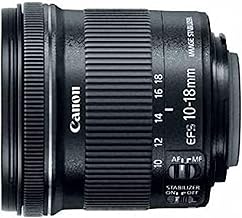
Best for beginner to intermediate APS-C photographers who want an affordable, lightweight wide zoom with image stabilization. This lens covers wide-to-wideish standard angles for landscapes, interiors, and atmospheric scenes. The drive system uses a lead screw and rack mechanism with stepping motor for focusing, and its focal length range is 10-18mm with a maximum aperture of f/4.5-5.6. Closest focusing distance is 0.72 feet (0.22 meters).
Who it’s best for: photographers starting with Canon EOS APS-C bodies seeking an affordable wide option without sacrificing stabilization or light weight. Why selected: combines practical wide-angle coverage with IS for steadier handheld shots during daylight and dusk. Limitation: slower maximum aperture at longer focal lengths may challenge low-light performance without higher ISO.
Rokinon FE14M-C 14mm F2.8 Ultra Wide Lens

Best for landscape, real estate, and astro work when you want maximum openness and detail. This ultrawide at f/2.8 delivers bright performance in low light and expansive perspective with a 115.7° angle of view on Canon EF mount. It uses a 14-element-in-10-group optical design aimed at sharpness across the frame.
Who it’s best for: photographers who prioritize ultra-wide coverage and low-light capacity over autofocus speed. Why selected: exceptional image quality at a wide angle with a fast aperture. Limitation: manual focus only, which can slow setups and require careful focusing at extreme angles.
Canon 17-40mm f/4L EF Ultra Wide Angle Lens

Best for full-frame enthusiasts needing a versatile ultra-wide that balances performance and price. The inner focusing system with USM delivers quick, accurate focusing, with a closest focusing distance of 0.28m (0.9 ft) and a rotating zoom system. This lens is favored for landscapes, architecture, and travel photography on full-frame bodies.
Who it’s best for: photographers who want a reliable L-series wide-angle option without breaking the bank. Why selected: strong image quality, durable build, and broad focal range for varied scenes. Limitation: not a fixed f/2.8, so limited low-light reach compared to faster primes.
Canon EF-S 10-18mm f/4.5-5.6 IS STM Lens (Renewed)

Best for budget-conscious buyers who still want stabilization and versatile wide-angle coverage on APS-C cameras. This renewed option preserves the same focal range and features as the new version, including the IS and STM drive system with a 10-18mm reach and 0.72 ft (0.22 m) minimum focusing distance.
Who it’s best for: students, hobbyists, or backup-lens shoppers on a tight budget. Why selected: value retention through renewal while delivering practical wide-angle capabilities. Limitation: renewed status may vary in cosmetic condition and warranty terms.
Canon EF 50mm f/1.8 STM

Best as a complementary prime for portraits, low-light subjects, and everyday shooting. This 50mm lens features a fast f/1.8 aperture ideal for shallow depth of field and subject isolation, with a practical angle of view that covers many standard scenes.
Who it’s best for: photographers needing a fast, compact prime for low-light work and characterful portraits. Why selected: inexpensive, lightweight, and highly versatile beyond wide-angle duties. Limitation: not a wide-angle option, so pair with a wide lens for landscapes.
Buying Guide
What matters most when choosing a wide-angle EF lens:
- Sensor compatibility: EF-S lenses suit APS-C bodies; full-frame users may prefer EF or EF-S with appropriate framing.
- Focal length range: 10-18mm and 14mm are popular for dramatic landscapes; 17-40mm adds versatility on full-frame.
- Aperture: faster apertures (f/2.8 or f/4) improve low-light performance and depth of field control; zooms generally have smaller maxima (f/4.5-5.6).
- Stabilization: built-in IS helps handheld shooting at wide angles, especially in low light or with slower shutter speeds.
- Autofocus vs. manual: prime ultra-wides may be manual focus (e.g., some Rokinon models); autofocus-enabled lenses offer faster setups for moving subjects.
- Optical quality and distortion: consider images wide open and stopped down; some lenses flatten perspective less than others.
FAQ
- Are wide-angle lenses good for beginner photographers? Yes, they help capture expansive scenes and architecture, especially on APS-C bodies with shorter focal lengths.
- Do ultra-wide lenses distort straight lines? Some barrel distortion can occur at the edges; many lenses include correction in-camera or in post-processing.
- Is image stabilization important on wide lenses? It helps with handheld shots in low light, but a sturdy tripod is often preferred for precise landscapes.
- Should I buy a zoom or prime ultra-wide? Zooms offer flexibility; primes like the 14mm f/2.8 often deliver sharper corners and faster apertures but require more planning.
- Can I use EF-S lenses on a full-frame camera? EF-S lenses are designed for APS-C; using them on full-frame may cause vignetting or incompatibility unless the camera supports crop mode.
- Is renewed or refurbished gear a good option? Renewed items can offer savings with verified condition, but check return policies and warranty terms.