Off-camera flash cables unlock creative lighting by letting you place light exactly where it’s needed. The best cables offer reliable TTL signaling, sturdy connectors, and rugged construction for on-location work. This guide highlights top-rated options that work with popular Canon and Nikon systems, with lengths ranging from compact to extended. Whether you’re shooting portraits, events, or product photography, these cables help you shape shadows, reduce hotspots, and keep your hands free. Below are five strong contenders, each reviewed with key features to help you choose the right cord for your setup.
| Product | Brand | Length | Compatibility |
|---|---|---|---|
| Neewer 1.3m TTL Off-Camera Cord | NEEWER | 1.3 m | Canon DSLR |
| JJC TTL Off-Camera Cord 1.3m | JJC | 1.3 m | Nikon TTL Flashes |
| Vello TTL Off-Camera Cord for Canon | VELLO | 0.5 m | Canon EOS (E-TTL / E-TTL II) |
| PHOLSY I-TTL Off-Camera Cord | PHOLSY | 2 m | Nikon DSLR |
| Pixel PF-802 4m TTL Off-Camera Cord | PIXEL | 4 m | Nikon / compatible flashes |
Neewer 1.3m TTL Off-Camera Cord
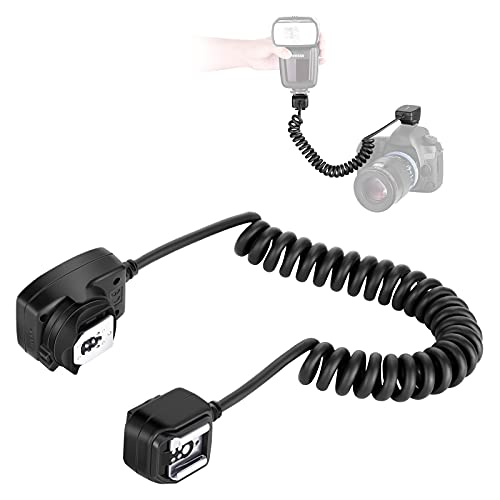
Length and design: 1.3 meters of heavy-duty, coiled cable that retracts for easy transport. The connection shoe includes a bottom shoe mount and a 1/4″-20 socket, while the opposite end provides a built-in tripod socket for mounting the Speedlite on a tripod. This setup gives you hands-free control while keeping the flash position flexible for portraits and events. The cord is designed to work with Canon DSLR bodies and compatible Speedlites, making it a practical, all-around option.
- Heavy-duty 1.3 m coiled cable
- Flash connection shoe with bottom mount
- 1/4″-20 threaded socket for brackets
- Built-in tripod socket for secure mounting
JJC TTL Off-Camera Cord 1.3m

Compatibility and design: This 1.3-meter coiled TTL cord is positioned as a Nikon-friendly replacement for the SC-28 cord. It features a flash shoe on the bottom and a 1/4″-20 threaded stud for mounting on brackets or tripods. The cord supports TTL signaling with compatible Nikon flashes, including SB-series models. The coiled design helps reduce tangling and keeps your workflow smooth when you’re moving between locations or adjusting light angles.
- 1.3 m coiled cord design
- TTL signaling for compatible Nikon flashes
- Flash shoe base and 1/4″-20 threaded studs
- Can be mounted on brackets or tripods via standard threads
Vello Canon Off-Camera TTL Cord

Compatibility and length: This Canon-focused, 0.5-meter coiled TTL cord is designed to integrate with Canon E-TTL and E-TTL II systems. It mounts to the flash via the standard shoe and supports 1/4″-20 threaded studs for accessory mounting. The compact length makes it ideal for close-front lighting or when you need a subtle off-camera setup in tight spaces, while still preserving full TTL control where supported by Canon flashes.
- Canon E-TTL / E-TTL II compatibility
- 0.5 m coiled cord for short-distance setups
- Flash shoe mounting and 1/4″-20 threaded studs
- Compact design for tight spaces
PHOLSY I-TTL Off-Camera Cord

Two meters of versatile control: The PHOLSY I-TTL cord offers a 2-meter coiled design that supports TTL, i-TTL, and manual flash control. It mounts to the flash shoe and to 1/4″-20 threaded studs, and includes a cold shoe locking ring and light stand lug for use with other lighting accessories. This setup helps reduce harsh shadows and is suitable for secure studio deployments or on-location shoots where you need reliable off-camera lighting without sacrificing control.
- 2 m coiled TTL cord
- TTL, i-TTL, and manual control
- Flash shoe mount and 1/4″-20 studs
- Cold shoe locking ring and light stand lug
Pixel PF-802 4m TTL Cord

The 4-meter TTL off-camera cord from Pixel supports multi-flash setups. It is designed to separate the flash from the camera’s top and can connect up to three flashes with synchronized TTL control, offering flexible angles for creative lighting. The PF-802 cord includes a standard flash shoe connection and 1/4″-20 threaded studs for mounting on stands or brackets, enabling more complex lighting arrangements for portraits or product shoots.
- 4 m TTL off-camera cord
- Supports multiple flashes (up to three)
- Separates flash from camera top with synchronized TTL
- Flash shoe connection and 1/4″-20 studs
Buying Guide
Key purchase considerations
When selecting an off-camera flash cable, consider the intended shooting environment, camera system, and lighting goals. The length affects reach and portability; longer cords enable more flexible setups but can introduce signal lag or tangling if not well shielded. TTL compatibility is essential if you rely on automatic flash exposure, while some setups require manual control for precise lighting. Durability of connectors and the overall build quality influences reliability in field conditions. A built-in tripod or light stand compatibility adds mounting versatility, especially for studio shoots or on-location sessions.
Connector design and mounting options
Most cords provide a flash shoe attachment, a 1/4″-20 threaded stud, and sometimes a built-in tripod socket. These features determine how you’ll position the flash and whether you can mount the unit on a light stand or clamp. Coiled cables save space and reduce clutter, but straight cables can be lighter and less prone to kinks in tight spaces. Check that the cable ends are compatible with your flash brand and model to ensure seamless TTL signaling and reliable power delivery.
TTL vs. manual control
TTL-capable cords automatically control flash exposure, which is helpful for fast-changing scenes and dynamic shoots. If you frequently work in controlled environments or use manual flash power for creative lighting, a non-TTL option or a cord that supports both modes gives you versatility. Some multi-flash setups, like the Pixel PF-802, enable synchronized TTL across multiple units, which can simplify complex lighting rigs.
Multi-flash support and expansion
For advanced lighting, consider whether the cord supports connections to multiple flashes. Cables designed for three or more units offer expanded creative possibilities, such as cross-lighting or rim lighting from several angles. Be mindful of compatibility with your flashes and any required accessories (such as locking rings or light stand lugs) to ensure secure, reliable operation in busy locations.
Durability, warranty, and brand reliability
Durable jackets, robust connectors, and secure locking mechanisms reduce wear from repeated assembly and disassembly. Look for kits that include protective sheathing or strain relief and verify warranty terms. Brand reputation matters when you depend on gear during important shoots; reputable brands generally provide better customer support and replacement parts over time.