Whether you’re filming YouTube tutorials, streaming live, or capturing crisp photos, a reliable LED flash or video light can dramatically improve image quality. This guide highlights five top-rated, easy-to-use options that work across major cameras, focusing on brightness, color accuracy, battery life, and portability. Each pick is chosen for versatility, from compact on-camera fill lights to powerful speedlites, helping you achieve natural-looking lighting in a variety of shooting environments.
| Product | Brand | Type | Key Benefit |
|---|---|---|---|
| Kiwifotos Mini LED Video Light | KIWIFOTOS | LED Video Light | Soft, accurate lighting for vlogs |
| RALENO LED Video Light | RaLeno | LED Video Light | Portable, long-usage with USB-C power |
| NEEWER BASICS N12L | NEEWER | Mini Flash / LED Light | Compact on-camera fill with multiple power levels |
| PHOTOOLEX FK300 | PHOTOOLEX | Flash Speedlite | High GN and wireless triggers |
| Neewer TT560 | NEEWER | DSLR Flash | Budget-friendly fill with flexible head |
Kiwifotos Mini LED Video Light For Cameras

The KIWIFOTOS mini LED light is designed for vlog shooting, selfies, and live streaming. It features 18 built-in ultra-bright LEDs that deliver a soft, evenly lit image, with a fixed 5600K color temperature for daylight-balanced results. The built-in 600mAh lithium battery provides roughly 1.2 hours of operation at maximum brightness, making it a convenient on-the-go option. It attaches to devices with a standard shoe mount or 1/4-20 screw, ensuring compatibility with many cameras, tripods, or smartphone grips.
- 18 LEDs for broad, even illumination
- 5600K color temperature for natural daylight balance
- 95+ color rendering index for accurate colors
- 600mAh battery with about 1.2 hours runtime at full brightness
- Compatible with shoe mounts or 1/4-20 screws
Raleno LED Video Light For Cameras

The RaLeno LED Video Light is a compact, versatile option for pictures, videos, and live streaming. It uses a panel light design with edge-lit technology and four diffusers to produce soft, uniform lighting. It delivers about 600Lux at 0.5 meters and includes a built-in rechargeable battery rated for roughly 80 minutes at full brightness. The light can be used while charging via USB-C, and it ships with a mini stand (minimum height ~3.74 inches, maximum ~7.09 inches) to adjust shooting height. The listed color range spans 3200K–5600K, suitable for a variety of environments.
- 12W panel with 600Lux at 0.5m
- USB-C power; usable while charging
- Mini stand included (3.74″–7.09″ height)
- 3200K–5600K color temperature
- CRI > 95 for accurate color rendering
NEEWER BASICS N12L Mini Camera Flash

The NEEWER BASICS N12L combines a compact on-camera flash with an LED video light for flexible lighting. It offers a guide number of 12 (ISO 100) and eight power levels (1/1 to 1/128). The unit includes a built-in 800mAh battery capable of about 500–700 flashes per charge. As a 2‑in‑1 device, it doubles as an LED light with 12 LEDs and nine brightness levels, while maintaining a steady 5600K color temperature for consistent results.
- GN 12 (ISO 100) with 8 power levels
- 800mAh battery; 500–700 flashes per charge
- 2-in-1 flash and LED light (12 LEDs, 9 brightness levels)
- 5600K color temperature
PHOTOOLEX FK300 Camera Flash

The PHOTOOLEX FK300 is a powerful hot‑shoe flash designed for Canon, Nikon, Sony, and other major brands. It offers a guide number GN33 at 35mm (ISO 100), with manual mode and S1/S2 wireless trigger options. A robust metal hot shoe, a 2.8‑second flash recycle time, automatic save function, and a test button support quick checks and efficient workflow. The FK300 can synchronize with either the main or secondary flash, enabling flexible lighting setups for portraits or events.
- GN33 (35mm, ISO100) for strong output
- Manual, S1 and S2 wireless triggering
- Metal hot shoe; 2.8s recycle time
- Automatic save function and test button
Neewer TT560 Speedlite
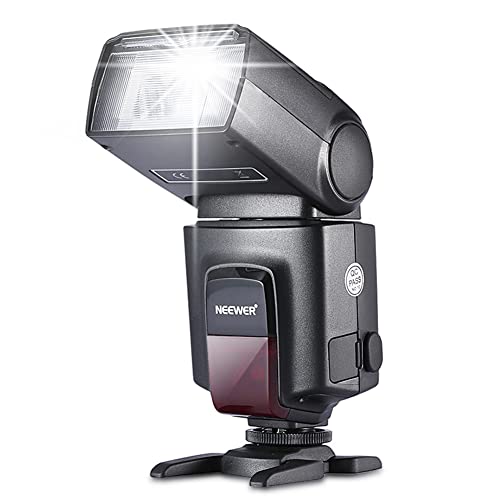
The Neewer TT560 is a traditional, budget‑friendly DSLR flash that emphasizes manual control over TTL functions. It offers vertical rotation from 0° to 90° and horizontal rotation from 0° to 270°, giving flexible bounce lighting options. This unit is compatible with Canon, Nikon, Sony, and other cameras via MI hot shoes, though it does not support TTL. It’s most suitable for photographers who prefer full manual control and want to shape light precisely on location.
- Vertical 0–90°; Horizontal 0–270° rotation
- Non-TTL, manual control
- Wide camera compatibility via MI hot shoe
- Not compatible with some Canon Rebel entry models
Buying Guide
On-Camera Lighting Essentials
LED video lights provide continuous illumination, making them ideal for video work, live streams, and close‑up scenes where you need steady brightness. Flashes deliver a quick, powerful burst of light, useful for freeze‑frames or high‑contrast portraits. The best setup often combines both: a reliable LED fill light for ambience and a capable flash for fall‑back lighting or strobe effects. Consider your primary use—video or stills—and pick a combination that simplifies your workflow without adding excessive bulk.
For most beginners, starting with a compact LED light like the KIWIFOTOS or RaLeno and a versatile flash such as the FK300 or TT560 provides immediate flexibility. This pairing supports a range of shooting scenarios from indoor vlogging to on‑location portraiture, while keeping portability in mind. As you gain experience, you can add a second light or upgrade to higher‑power options tailored to your evolving style.
Color Temperature And Color Rendering
Color temperature controls help you match ambient light and set the mood. A daylight-balanced 5600K light is standard for most indoor shooting, while a warmer 3200K setting is useful in mixed or tungsten environments. Color rendering index (CRI) measures how accurately the light renders colors; higher CRI yields more natural tones. Look for CRI values around 95 or higher when buying LED lights or integrated lighting kits to ensure skin tones and fabrics appear natural on camera.
Several of the products listed offer adjustable ranges (for example, 3200K–5600K) and high CRI ratings, which makes them versatile across scenes. If your shoots involve fashion, interiors, or skin tones that must look authentic, prioritize lights with broad color ranges and high CRI scores rather than simply maximum brightness.
Battery Life And Power Options
On‑camera lighting often requires portability. Lights with built‑in rechargeable batteries are convenient for travel and street shoots, but battery life varies. Some models allow pass‑through charging so you can power and use the light simultaneously via USB‑C, a critical feature for longer sessions. If you frequently shoot away from outlets, consider devices that offer removable batteries or external power options to avoid interruptions.
For instance, the RaLeno light includes an approximate 80‑minute runtime and USB‑C charging, while the N12L flash‑light combo runs on an 800mAh battery with hundreds of flashes per charge. If you plan on extended shoots or events, pair a compact LED light with a reliable flash and carry spare power sources to maximize uptime.
Mounting, Compatibility, And Portability
Mounting flexibility expands where you can place lighting. Shoe mounts and 1/4‑20 threads enable use with cameras, tripods, and accessory rigs. Consider the overall size and weight of the light, especially for handheld vlogging or travel. If you frequently shoot outdoors or on the move, a compact, low‑weight light that attaches to your camera or a small stand is often the most practical choice.
Before purchasing, verify compatibility with your camera brand and model, as some older DSLRs or entry‑level models have limited hot‑shoe support. The included stands and diffusers in options like the RaLeno package illustrate how a small accessory kit can improve light quality without adding significant bulk.
Budget, Value, And Longevity
Price usually reflects brightness, color accuracy, build quality, and how long the kit will last under regular use. For hobbyists, affordable options like the TT560 deliver dependable results, while enthusiasts may prefer LEDs with higher CRI and broader color ranges. Evaluate warranty terms, availability of spare parts, and the supplier’s customer support when assessing long‑term value. Cheaper models can suffice for light everyday use, whereas higher‑end kits suit more demanding productions.
Brand Ecosystems And Compatibility
Brand ecosystems influence how easily you can expand your lighting setup. Some brands offer complete accessory lines (diffusers, stands, gels, batteries), which can simplify upgrades over time. Check whether the lights are compatible with standard accessories across brands to avoid being locked into a single system. If you already own a camera system, pairing a compatible flash or LED light with existing stands and modifiers reduces wasted purchases and ensures smoother workflows.
Practical Setups And Use Cases
For video creators, a compact LED light paired with a reliable fill flash yields balanced, natural lighting while leaving room to add a secondary key light or hair light as needed. For portrait or event photography, a strong external flash with manual control and fast recycle times can provide striking highlights and dynamic range. In both cases, diffusion modifiers (softboxes, diffusers) and reflectors help sculpt light to minimize harsh shadows and improve detail.
Maintenance And Care
Keep LED panels and flash heads clean and free of dust. Store equipment in a padded bag to prevent impact damage, especially for portable lights and stands. Regularly check battery health and replace worn components such as diffusers and diffusion panels to maintain light quality. When not in use, remove batteries to extend shelf life and avoid corrosion on connectors.