Global shutter cameras have become essential for capturing fast action without motion artifacts in cinema-inspired workflows, robotics, and industrial vision. The following five USB-connected models offer compact, affordable options that suit desktop rigs, embedded systems, and field testing. Each unit provides a global shutter sensor, high frame rates, and broader lenses to minimize distortion while delivering sharp, accurate imagery. Whether you’re analyzing sports performance, calibrating machines, or prototyping laser engraving systems, these cameras present dependable performance across a range of environments. Use the quick table below for a fast feature comparison.
| Product | Brand | Resolution / Frame Rate | Lens / Field of View |
|---|---|---|---|
| ELP Wide Angle Global Shutter Camera | ELP | 2MP 1920×1200 at 90fps | 120° distortion-free lens; HFOV ~126° |
| ELP 1080P Global Shutter Webcam | ELP | 2MP 1920×1200 at 90fps | 5–50mm varifocal lens |
| SVPRO Dual-Lens Global Shutter Camera | SVPRO | 1200P@60fps; 2MP | Dual M12 lenses; ~85° viewing angle |
| IFWATER Global Shutter Cam | IFWATER | 1200P; 90fps | 120° no-distortion lens |
| Magnolia Global Shutter Module | Magnolia | 1200P; 90fps | 200° fisheye lens |
ELP Wide Angle Global Shutter Cam

Global Shutter technology enables capturing fast-moving subjects without rolling artifacts, delivering crisp, accurate images even in high-speed scenarios. This model uses a 2MP sensor with 1920×1200 resolution at up to 90 frames per second, ensuring smooth footage of rapid action. The AR0234-based sensor delivers sharp color and detail, while the 120-degree distortion-free lens and an HFOV of about 126 degrees provide broad situational awareness. Its compact 38mm by 38mm board fits tight installations that standard cameras cannot accommodate, making it ideal for embedded rigs and hidden camera setups.
Designed for versatility, this unit can be integrated into a variety of video systems for personal or industrial use—ranging from laser engraving workflows to machine-vision testing on production lines. The combination of global shutter performance, wide coverage, and small form factor makes it suitable for desktop monitoring, robotics experiments, and discreet installations where space is at a premium.
ELP 1080P Global Shutter Webcam

This model emphasizes a user-friendly, close-up capable configuration with manual zoom and a variable focus system. It also employs a global shutter for reliable capture of fast objects, providing a 2MP sensor with 1920×1200 resolution at up to 90fps for smooth motion. The 5–50mm varifocal lens lets you tune the field of view and working distance, while the adjustable zoom and brightness control offer versatility for tabletop demos, close-up inspections, and dynamic tabletop sports analysis. The AR0234 sensor aids in crisp color and detail at varied distances.
The flexible lens system makes it well suited for laptop-based setups, live demonstrations, or field testing where distance to the subject changes. Its combination of 90fps performance and manual focus/zoom helps optimize depth of field and framing without sacrificing motion accuracy, which is valuable for cinematic previews, product inspections, and quick prototyping in a compact package.
SVPRO Dual-Lens Global Shutter Camera

The SVPRO model uses a 3D Sync Stereo USB camera module with dual M12 lenses, enabling synchronized capture for robust stereo imaging. It employs a 1/2.9” color global shutter OG02B10 sensor, delivering up to 1200P at 60fps, with 2MP image quality. This configuration reduces rolling distortions and supports high-speed subjects across complex scenes. It also provides enhanced light handling and a broad use case range—from sports analytics to VR, robotics, and 3D printing workflows—across Windows, Linux, Android, and Mac OS platforms.
The design emphasizes low distortion and dependable dual-lens operation for depth perception and environmental awareness. The camera’s global shutter capability ensures precise temporal alignment between the two streams, which is crucial for accurate 3D measurements, machine-vision tests, and synchronized capture in research or industrial environments.
IFWATER Global Shutter 90fps Cam

IFWATER’s global shutter design delivers crisp imagery with a solid 90fps performance at 2MP and 1920×1200 resolution, ensuring smooth capture of fast actions without rolling artifacts. The camera features a distortion-free 126-degree lens, offering an expansive field of view for industrial monitoring, sports analysis, or robotics experiments. The small, embedded 38x38mm form factor supports integration into tight spaces and embedded systems such as Jetson Nano or Raspberry Pi projects, enabling compact, high-speed image capture in constrained environments.
With its broad angle and robust shutter performance, this camera suits applications requiring wide situational awareness, steady motion capture, and reliable data gathering in real-time. The combination of a compact footprint, strong frame rates, and distortion control makes it a practical option for labs, workshops, and automated testing environments where space and reliability matter.
Magnolia Global Shutter Module
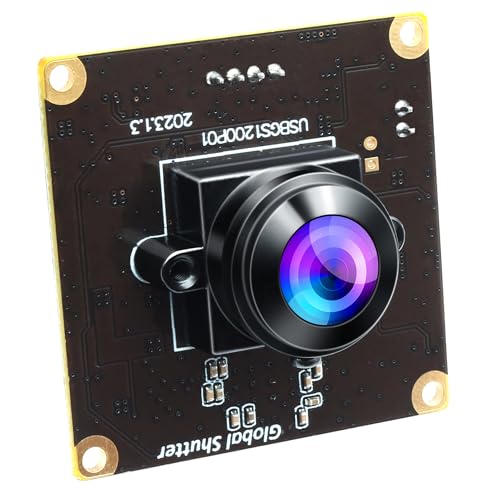
Magnolia presents a 1200P, 90fps global shutter module with a wide 200-degree fisheye lens, enabling near-complete coverage of a scene with one camera. The high-speed 2MP sensor paired with a fisheye lens provides broad situational awareness ideal for machine-vision, drone navigation, or VR demonstrations. The 200° lens offers expansive field coverage while maintaining image clarity for fast-action filming and motion analysis, making it a strong choice for projects requiring panoramic capture from a single device.
Designed for industrial and educational use, Magnolia emphasizes a compact footprint and straightforward integration into existing systems. The broad fisheye perspective supports unique angles and camera placements, helping teams test immersive viewpoints, track large-scale movements, or implement early-stage computer-vision experiments without complex multi-camera rigs.
QILOVE 1200P Global Shutter Dual-Lens

Note: This entry references a prominent 3D VR stereo-capable design featuring dual lenses and a global shutter sensor. The module delivers 3200x1200p at 60fps in MJPEG, with 120fps at 1600×600 for fast-motion capture. The distortion-free dual-lens M12 design provides synchronized data streams with a wide 112-degree HFOV. Such a configuration is well-suited for robotics, 3D measurement, and intelligent transportation scenarios where depth perception and real-time data fidelity are essential for accurate decision-making.
Across applications such as robot vision, VR/AR prototyping, and automated inspection, this camera supports diverse platforms and enables precise, synchronized capture across two viewpoints. Its global shutter capability helps ensure crisp frames in fast sequences, reducing artifacts and enabling reliable depth analysis and multi-camera fusion for immersive visualization or analytics tasks.
Buying Guide
When selecting a global shutter camera for cinema-like or industrial use, several considerations influence performance and value. First, assess the shutter type’s impact on motion: global shutters prevent rolling distortions in fast action, which is vital for high-speed sports, drone footage, and engineering tests. Second, examine resolution and frame rate trade-offs. While 4K or higher resolutions are attractive, many USB global shutter models top out around 1080p to 1200p with 60–90fps, which is often more than adequate for desktop rigs and embedded projects while preserving bandwidth and processing headroom.
Lens design and field of view are critical for framing and scene coverage. Distortion-free wide-angle lenses help maintain geometry for measurement tasks and machine-vision pipelines, whereas fisheye or dual-lens configurations provide expansive coverage or depth perception. For robotics, VR, or NASCAR-style analytics, synchronized dual lenses can enable depth mapping and stereo analysis, albeit with more complex setup and higher data requirements.
Platform compatibility and software support are essential. Verify that the camera works with your preferred operating system (Windows, Linux, macOS) and whether driver-free or SDK-based integration is available for your project. USB power and data bandwidth should align with your host device and motherboard capabilities to avoid bottlenecks. Lastly, consider physical footprint and mounting options—compact boards help with discreet installations, while larger housings may ease alignment and lens changes in test benches.
In summary, the ideal choice balances resolution, frame rate, lens coverage, and system compatibility with your workflow. If you prioritize motion fidelity and compact form, any of the listed models with global shutter capabilities will provide reliable image quality for high-speed tasks. For stereo vision or depth-focused projects, models offering dual lenses can deliver richer data streams, provided your processing pipeline can handle the increased data load. By aligning these factors with your budget, you can select the most suitable camera for cinema-style capture, robotics, or industrial vision needs.