Best DSLR Lenses for Landscape Photography: Top Wide and Tele Picks
Landscapes demand clarity, depth, and dynamic range. This guide identifies five DSLR lenses well-suited for landscape photographers, from ultra-wide to versatile telephoto options. Each pick targets different shooting situations—wide vistas, distant details, macro-inches, and everyday versatility. The selections suit enthusiasts, hobbyists, and semi-professional shooters seeking reliable performance without specialized gear. Use the table below to compare core strengths and trade-offs at a glance.
| Product | Best For | Key Strength | Notes |
|---|---|---|---|
| Canon EF-S 10-18mm f/4.5-5.6 is STM | Wide landscapes | Ultra-wide focal range; image stabilization | Entry to mid-level budget option for wide scenes |
| Canon EF 50mm f/1.8 STM | Portraits with atmospheric foregrounds | Bright f/1.8 aperture for low light and separation | Compact prime with solid sharpness |
| Canon EF 75-300mm f/4-5.6 III (Black) | distant landscape details | Broad telephoto zoom for compression and distant subjects | Affordable tele zoom for reach |
| Canon EF 75-300mm f/4-5.6 III Telephoto (Renewed) | Budget telephoto option | Decent reach at a lower price point | Renewed condition; verify warranty and condition before purchase |
| Altura Photo 58mm Wide Angle with Macro | Macro + wide field for scenes and close-ups | Attach-on wide angle with detachable macro lens | Compatible with many Canon bodies via 58mm filter thread |
Canon EF 50mm f/1.8 STM Lens

Focal Length and Aperture: 50mm, f/1.8. Best For: creative foreground interest and low-light scenes where a brighter lens helps. Why Selected: The prime delivers sharp image quality with a compact form factor and affordable price, making it a practical addition for landscape observers who also shoot at dusk or dawn. Limitation: Narrow field of view compared to wide-angle lenses, so it’s less ideal for expansive landscapes. This lens is best for adding selective foreground elements or isolating subjects within the frame.
Canon EF-S 10-18mm f/4.5-5.6 is STM
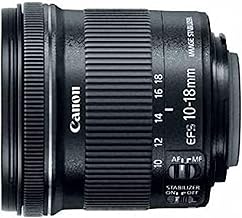
Focal Length and Aperture: 10-18mm at f/4.5-5.6. Best For: wide landscape scenes and interior architecture with minimal distortion. Why Selected: This ultra-wide zoom enables dramatic perspective and broad vistas, with STM autofocus for smooth operation. Caution: The variable aperture means slower performance in low light at the longest end; consider a tripod for dusk or dawn shots. Choose this if you want maximum scene coverage without stepping up to more expensive primes.
Canon EF 75-300mm f/4-5.6 III Telephoto Zoom (Renewed)

Focal Length and Aperture: 75-300mm, f/4-5.6. Best For: distant landscape details and compressed perspective at long reach. Why Selected: A versatile budget tele zoom that adds reach for distant mountains or architectural details in a landscape scene. Limitation: As a variable aperture zoom, performance can dip in low light and at longer focal lengths; a tripod helps stabilize shots. Best for: enthusiasts seeking cost-effective reach rather than top-tier optics.
Canon EF 75-300mm f/4-5.6 III Telephoto Zoom (Black)

Focal Length and Aperture: 75-300mm, f/4-5.6. Best For: versatile tele reach for landscapes with distant features. Why Selected: A classic budget telephoto that pairs well with a standard kit for travelists who want to capture both wide scenes and distant details. Limitation: Smaller maximum aperture reduces performance in lower light; consider shooting in daylight or using a tripod for stability. Choose this if you want a simple, travel-friendly tele option without premium pricing.
Altura Photo 58mm Wide Angle with Macro

Focal Length and Aperture: 58mm wide angle with detachable macro. Best For: landscape scenes that benefit from a wide field of view and close-up detail. Why Selected: The attachment expands the field of view while the detachable macro lens enables high-resolution close-ups of foreground subjects, adding depth to landscape storytelling. Limitation: Designed as an attachment, it requires a compatible base lens with a 58mm thread, which may not fit all bodies or lenses. Best for users who want flexible wide-to-close-up capabilities without changing lenses.
Buying Guide: Key Considerations For Landscape Lenses
What focal length best suits your typical landscapes? Wide-angle options (like 10-18mm) capture expansive skies and scenes, while telephotos (75-300mm) compress scenery and reveal distant details. Do you need image stabilization? If you shoot handheld, stabilization can help, especially on longer focal lengths. How important is low-light performance? Prime lenses with wide apertures (f/1.8) perform better in dim light but have narrower fields of view. Consider the compatibility with your Canon DSLR body and available filter threads for attachments like wide-angle adapters.
What about versatility versus specialization? A zoom like 75-300mm offers flexibility across scenes, but a dedicated wide-angle lens yields stronger panoramic results. For macro-capable shots within landscapes, attachments such as macro-capable wide angles can add texture to foreground elements. Always weigh budget, weight, and transportability against the need for reach, perspective control, and detail capture on location.
FAQ
- Which lens is best for sweeping landscape vistas? Ultra-wide or wide-angle lenses (such as 10-18mm) are typically the best choice for capturing broad horizons and dramatic skies.
- Is a telephoto lens necessary for landscapes? Not strictly necessary, but a telephoto can reveal distant details and create compressed compositions that accentuate depth.
- Do I need image stabilization for landscape lenses? Stabilization helps in low-light or dusk/dawn shooting and when you shoot handheld; otherwise, a sturdy tripod can compensate for camera shake.
- Are fixed focal length lenses better for landscapes? Prime lenses often offer sharper image quality and wider maximum apertures, but zooms provide flexibility across scenes without changing lenses.
- Can attachments like macro adapters be useful for landscapes? Yes, macro attachments can deliver close-up textures and foreground interest that enhance landscape storytelling.
- What should I consider if buying renewed or used lenses? Check condition, warranty availability, and return policy to ensure reliable performance for landscape work.