Best Compact Video Tripods for Stable on-the-Go Filming
Answer: For creators seeking portable stability, compact video tripods deliver smooth pans, reliable support, and quick setup. This guide highlights five compatible options, detailing who they’re best for, strengths, and potential limits. Ideal buyers include travel videographers, vloggers, live-streamers, and hobbyists needing lightweight yet sturdy solutions.
| Product | Best For | Weight (approx) | Load Capacity |
|---|---|---|---|
| K&F CONCEPT A305A3+FH-04 | Professional video work on the go | 2.9 lb | 6.6 lb |
| SmallRig CT-10 (2 in 1) | Travelers needing monopod flexibility | varies | 33 lb |
| K&F CONCEPT O234A7+FH-03 | Vloggers and live streams | varies | 11 lb |
| COMAN Q6 Fluid Head Tripod | DJI gimbal users and outdoor shooters | varies | 17.6 lb |
| SmallRig Travel Tripod | Ultralight, compact setups | ~2.95 lb | 5 kg |
K&F CONCEPT 73″ Aluminum Travel Tripod with Fluid Head

Best for: Serious shooters who need a tall, stable setup with smooth video. The fluid head delivers precise panning and tilting for cinematic moves, while the 360° panorama and ±85° tilt range help track subject motion in sports or interviews.
Why chosen: It combines a robust aluminum build with a lightweight 2.9 lb frame and a 6.6 lb load limit, making it suitable for most DSLRs, mirrorless cameras, and camcorders. The 5-section legs with flip locks enable quick height adjustments from 19″ to 73″, and the reversible center column supports low-angle shots for macro or pet perspectives.
Best for: Outdoor shoots where height flexibility and stability are priorities. Caution: Ensure your camera setup remains balanced, especially at higher extensions, to avoid tipping.
SmallRig 71″/ 180cm Aluminum CT-10 Tripod & Monopod
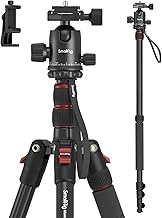
Best for: Travelers and content creators who want a versatile 2-in-1 setup. This model can switch between tripod and monopod quickly, supporting diverse shooting styles on the road.
Why chosen: It offers wide compatibility with 1/4″-20 and 3/8″-16 threaded holes, plus the ability to invert the center pole for low-angle shots and macro work. The note: some users may pair it with additional balance accessories if using a telephoto lens, to maintain stability during longer shoots.
Best for: Light hiking and on-the-go shoots. Caution: The 2-in-1 design requires careful balance when switching modes to preserve stability.
K&F CONCEPT 83″ Camera Video Tripod
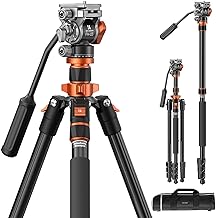
Best for: Photographers and videographers needing high reach with strong load support. The 11 lb maximum payload suits heavier setups while maintaining fluid head performance for multi-angle shoots.
Why chosen: The fluid head offers smooth motion with ±90° tilt and 360° rotation, plus a 20″–80″ height range via four-section legs and quick-release locks. The tall folded length makes it a practical travel companion for outdoor shoots, live events, or studio work outside the usual reach.
Best for: High-angle or overhead shots when you have space, better for static setups rather than fast-action handheld work. Caution: The taller design can be bulky in tight spaces.
COMAN Fluid Head Tripod With Versatile QR System

Best for: Filmmakers who need quick camera swaps between tripod and gimbal-like moves. The Q6 fluid head supports 360° pan and ±70–90° tilt, with a robust aluminum build for field use.
Why chosen: It includes a user-friendly QR plate system to facilitate fast switching, plus integrated side holes for accessories like mics or monitors, enhancing on-location shooting flexibility. The data notes a heavy-duty construction that’s suitable for dynamic shoots, though the design may be heavier than ultra-light options.
Best for: On-site shoots requiring rapid reconfiguration. Caution: The QR assembly, while convenient, may require occasional alignment checks for consistent balance.
SmallRig Portable Travel Video Tripod

Best for: Compact setups where weight, size, and stability matter equally. This carbon fiber tripod folds compactly and is designed for travel videography with a strong anti-vibration head.
Why chosen: The carbon fiber construction offers excellent stiffness-to-weight ratio, with a maximum 5 kg payload and 360° pan plus -70° to 90° tilt. It folds to a small footprint and includes a carrying bag for portability. The potential limit is the smaller maximum height compared to taller tripods, which may affect certain shooting angles.
Buying Guide
What should you consider when choosing a compact video tripod?
- Weight and Load Capacity: Match the tripod’s weight with your camera setup. Lightweight models excel for travel, but ensure the load rating covers your lens and accessories.
- Height Range: If you often shoot low-to-high angle, prioritize models with adjustable center columns and high maximum heights.
- Fluid Head Quality: For video, a smooth pan and tilt is essential. Look for fluid heads with good damping and a wide tilt range.
- Quick-Release System: Quick setup and reliable locking mechanisms save time during shoots. Verify compatibility with your quick-release plates.
- Travel Footprint: Consider folded length and weight. Carbon fiber options often balance compactness with rigidity.
- Monopod vs Tripod Flexibility: 2-in-1 designs add versatility but may trade some stability. Decide based on typical shooting environments.
- Accessory Support: Side holes, leveling, and bubble levels can help precise framing, particularly for panoramic or multi-angle shoots.
Frequently Asked Questions
- What is the advantage of a fluid head on a compact tripod?
A: It provides smoother panning and tilting, reducing abrupt movements during video capture. - Do taller tripods necessarily be less portable?
A: Not always; many compact travel tripods compress to a small size while still offering tall working heights. - Is carbon fiber worth the extra cost for travel tripods?
A: Yes for lighter weight and sturdiness, especially when frequently carrying gear on foot or by transit. - Can I convert a tripod into a monopod?
A: Some models offer 2-in-1 functionality for flexibility, but confirm stability when fully extended. - What should I check before buying for DJI gimbal setups?
A: Ensure the head and QR plate system are compatible with your gimbal and balanced for your camera. - Are there any limits with low-angle shooting on tall tripods?
A: Inverted center columns help, but you may need to place the tripod closer to the subject to avoid tipping and ensure stability.