Best Cameras for Planetary Imaging: Top Picks for Astrophotography Enthusiasts
Planetary imaging benefits from compact cameras designed for high frame rates, low noise, and good color fidelity. This guide highlights five accessible options ideal for beginners through intermediate observers. Each choice is evaluated for who it suits best, common limitations, and how it compares to alternatives. A quick summary table follows to help you compare at a glance.
| Product | Best For | Key Benefit |
|---|---|---|
| SVBONY SV105 | Around-the-moon hobbyists | Plug-and-play with real-time video |
| SVBONY SV305C Pro | Serious planetary detail | High frame rate with low readout noise |
| Celestron NexImage 20 | Newcomers wanting ease | 20 MP high-resolution sensor |
| SVBONY SC715C | 4K planetary captures | IMX715 sensor with high dynamic range |
| FIBONAX 4K USB Camera | Budget entry with 4K option | ASCOM/UVC compatibility |
Note: Each product is positioned to address common user goals—whether you prioritize ease of use, resolution, or frame rate. Consider your telescope focal length, filter choices, and software workflow to select the best match.
SVBONY SV105 Telescope Camera

The SV105 is a beginner-friendly entry point for planetary imaging, designed for lunar and planetary targets. It records real-time video and connects to a laptop or PC without complex setup. Best for hobbyists who want quick results with minimal driver trouble. A limitation is that it relies on external software like Sharpcap on Windows and AstroDMx Capture on Linux for full functionality.
Best for: Beginners who want easy start-up and quick lunar/planetary videos.
Why selected: Simple plug-and-play operation and real-time viewing suit new astronomers exploring planetary imaging.
Limitations to know: Requires separate software for full capture on some systems; limited internal processing power may affect advanced stacking.
SVBONY SV305C Pro Telescope Camera

The SV305C Pro uses the IMX662 sensor for high sensitivity and low noise, delivering sharper planetary details even in challenging skies. Its 1920×1080 resolution at 107 FPS supports capturing fast-moving events, such as Jovian cloud belts. Best for dedicated planetary work where frame rate and clarity matter. A potential downside is heavier data throughput requiring fast storage and capable processing hardware.
Best for: Observers pursuing crisp, fast captures of Jupiter, Saturn, and Mars.
Why selected: Ultra-low readout noise and high frame rate enable cleaner detail under typical backyard seeing.
Limitations to know: Higher data load may demand robust computer and storage setup; smartphone compatibility is limited.
Celestron NexImage 20 Solar System Imager

The NexImage 20 emphasizes ease of use for Solar System imaging. It features a 20 MP AR2020 back-illuminated CMOS sensor for high-resolution lunar and planetary captures with good color fidelity. Built for straightforward plug-and-play setup, it’s a strong pick for beginners focusing on Moon and planet details. Limitations include less flexibility for advanced processing compared with higher-end systems.
Best for: Beginners who want high-resolution planetary shots with minimal setup.
Why selected: Strong overall image quality and straightforward workflow suits entry-level users.
Limitations to know: May offer fewer advanced features for experienced imagers seeking fine control.
SVBONY SC715C Telescope Planetary Camera
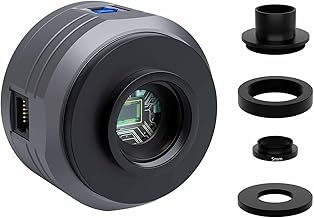
The SC715C uses the IMX715 sensor with 1.45 μm pixels and a 512 MB DDR3 cache, delivering high dynamic range and low noise for detailed 4K-level planetary imaging. It’s not router-friendly with mobile devices and requires dedicated software. Best for enthusiasts seeking high-quality planetary frames and smooth video capture. A caveat is the need for compatible software and a stable desktop workflow.
Best for: Serious planetary imagers aiming for high detail and dynamic range.
Why selected: IMX715 sensor and large cache reduce noise and delays for crisp captures.
Limitations to know: Not smartphone-friendly; software compatibility and focusing rely on telescope setup.
FIBONAX 4K USB Astronomy Camera

The FIBONAX camera offers an entry-level path with 8 MP capable of 4K or 1080p video. It provides ASCOM driver support and UVC plug-and-play compatibility, making it easy to integrate with common astronomy software workflows on Windows. Best for budget-conscious buyers who still want 4K readiness. A limitation is that basic models may lack some advanced planetary-specific features found in pricier options.
Best for: Budget-friendly beginners needing 4K live viewing.
Why selected: Combines 4K capability with broad software compatibility for versatile use.
Limitations to know: May not include specialized planetary processing features; performance depends on telescope compatibility.
Buying Guide: How to Choose Your Planetary Imaging Camera
What resolution do you need? For planetary imaging, higher frame rate and low noise often trump extremely high still-image resolution. Consider 1080p at high FPS or 4K options if you plan to stack many frames.
What sensor type matters? Back-illuminated CMOS sensors deliver good low-light performance. IMX-series sensors provide strong color and detail for planets. Check readout noise figures to gauge potential image clarity.
How important is software compatibility? Some cameras need specific capture software or drivers (Sharpcap, AstroDMx, ASCOM). Ensure your computer OS and telescope setup are supported.
What about interface and storage? USB 2.0 or USB 3.0 impacts data transfer. Plan for fast storage if you’re capturing high-frame-rate video or stacking many frames.
Is portability a factor? If you travel with gear, a lighter camera with straightforward setup may improve the observing experience.
Practical Comparison Questions
- Best for ease of use: SV105 for beginners seeking quick results.
- Best for high-detail frames: SV305C Pro or SC715C for dynamic range and resolution.
- Best for new users on a budget: NexImage 20 or FIBONAX 4K for value and compatibility.
FAQ
- What makes a camera good for planetary imaging? A camera with high frame rate, low readout noise, and good dynamic range for sharp, detailed frames.
- Do I need a dedicated astronomy laptop? Not always; many cameras work with standard PCs, but a capable CPU and fast storage help with stacking and processing.
- Can I use smartphone apps with these cameras? Some require desktop software; many do not offer full smartphone compatibility.
- Is 4K necessary for planetary imaging? Not strictly; 1080p at high FPS often yields excellent results, with 4K offering more detail if your setup supports it.
- Should I choose USB 3.0 over USB 2.0? USB 3.0 reduces transfer bottlenecks when streaming high-frame-rate video or stacking many frames.