Best Budget 35mm Lens Options for Every Canon, Nikon, Sony, and More
Looking for a budget-friendly 35mm lens that still delivers solid image quality? This guide showcases five strong choices across major brands, highlighting who each lens is best for and why. Whether you shoot with Canon EOS R, Nikon DSLR, Sony full-frame, or an older Nikon DX system, there’s a practical option here. The list emphasizes value, portability, and reliable performance for everyday photography, street portraits, and casual travel shots.
| Product | Brand | Mount / Use | Key Benefit |
|---|---|---|---|
| Canon RF35mm F1.8 is Macro STM Lens | Canon | Canon RF Mount | Macro capability with 0.5x magnification |
| YONGNUO YN35mm F2 | YONGNUO | Canon EF Mount | Low-cost prime with versatile focus options |
| Sony FE 35mm f/1.4 GM | Sony | FE Mount | High-end brightness and resolution with G Master quality |
| Nikon AF-S DX NIKKOR 35mm f/1.8G | Nikon | Nikon F DX | Compact, lightweight DX-format prime |
| Nikon 35mm f/1.8G AF-S DX (Renewed) | Nikon | DX Mount | Renewed option with full accessory package |
Canon RF35mm F1.8 Is Macro STM Lens

The Canon RF35mm F1.8 is Macro STM Lens is a compact macro option designed for EOS R series mirrorless cameras. It offers 0.5x magnification and a minimum focusing distance of 0.56 ft (0.17 m), enabling close-up shots with natural perspective. The control ring allows direct setting changes for quick adjustments on the fly. Best for Canon shooters who want macro capability in a lightweight, travel-friendly lens. Avoid this if you primarily shoot distant subjects or need extensive telephoto reach, as macro emphasis can limit other focusing distances.
YONGNUO YN35mm F2
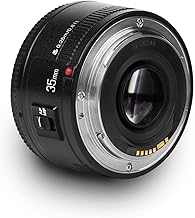
YONGNUO YN35mm F2 is a budget fixed-prime lens for Canon EF-mount cameras. It provides a classic 35mm perspective with a practical minimum focusing distance of 0.25 m and a maximum magnification of 0.23x. This lens is best for budget-minded photographers using Canon EF DSLR bodies who want a lightweight, everyday prime for street and travel photography. Choose this if you need a simple, affordable option, and be aware that build and optics may not rival premium brands at higher magnifications.
Sony FE 35mm f/1.4 GM

The Sony FE 35mm f/1.4 GM is a high-end option for full-frame Sony cameras, featuring a bright F1.4 maximum aperture for exceptional brightness and depth of field control. It incorporates two XA (extreme aspheric) elements to deliver sharpness across the frame. Best for photographers seeking top-tier image quality, striking bokeh, and reliable performance in low light. Better for serious enthusiasts and professionals; it can be less ideal for budget-focused buyers who prioritize portability or cost.
Nikon AF-S DX NIKKOR 35mm f/1.8G

The Nikon AF-S DX NIKKOR 35mm f/1.8G is a compact prime designed for Nikon DX-format bodies. It offers a 52.5mm equivalent focal length and a bright f/1.8 aperture for everyday photography, including portraits and street scenes. Best for Nikon DX shooters seeking a lightweight, affordable option with solid low-light performance. Limitations include its DX-format crop, which does not suit full-frame cameras without vignetting or crop mode considerations.
Nikon 35mm f/1.8G AF-S DX (Renewed)

This renewed Nikon 35mm f/1.8G DX offers a budget-friendly way to acquire a sharp standard prime for Nikon DX-format cameras. It includes the necessary accessories and a full USA warranty. Best for budget-conscious Nikon users who want a reliable, compact 35mm option with the convenience of renewed stock. A potential limitation is that renewed products may have cosmetic wear or shorter-term reliability, though often closely matched to new in function.
Buying Guide
What should you consider when buying a budget 35mm lens?
- Mount compatibility: Ensure the lens matches your camera’s mount (Canon RF, Nikon F DX, Sony FE, etc.).
- Sensor format: DX vs. full-frame affects field of view and performance; some lenses are optimized for crop sensors.
- Aperture needs: A wider aperture (f/1.4–f/2) yields better low-light performance and subject separation; be mindful of size and price trade-offs.
- Macro capability: If you plan close-up work, macro-capable lenses like the Canon RF option may be advantageous.
- Build and weight: Budget lenses vary in heft; consider portability for travel and street shooting.
- Brand ecosystem: Lenses from your camera brand often maintain better compatibility with autofocus and metering.
Practical Buying Questions
- Which budget 35mm lens is best for Canon EOS R?
– The Canon RF35mm f/1.8 is Macro STM offers macro capability and compact design, suitable for close-ups and everyday shots on EOS R. - Which option is best for Sony full-frame users on a budget?
– Sony FE 35mm f/1.4 GM provides top-tier image quality but at a higher price; it’s best if budget allows for premium performance. - Is a DX-format 35mm lens a good choice for Nikon crop bodies?
– Yes. The Nikon AF-S DX 35mm f/1.8G is designed for DX bodies and remains a practical, light option with solid performance. - What’s a reliable renewals option for Nikon DX?
– Nikon 35mm f/1.8G AF-S DX (Renewed) offers a cost-effective route with full accessories and warranty considerations. - Do I need macro capability for street photography?
– Not necessarily, but macro-capable lenses add versatility for close-range subjects and creative perspectives.
FAQ
- What is the advantage of a 35mm prime on APS-C cameras?
– It provides an equivalent focal length around 52–56mm, offering a natural perspective for everyday shooting. - Do budget 35mm lenses compromise on sharpness?
– Some may have softer performance at the corners wide open, but many deliver solid sharpness when stopped down. - Are macro features useful for travel lenses?
– Yes, macro capability lets you capture small details—flowers, textures, and jewelry—without a separate macro lens. - Is a f/1.4 aperture necessary for all budgets?
– Not necessary; f/2.0–f/2.8 lenses are typically lighter and more affordable while still performing well in daylight.