Best 80mm Refractor for Astrophotography: Top Picks for Clear, Colorful Deep-Sky Imaging
Looking for an 80mm refractor that balances sharp optical performance with practical imaging features? This guide highlights five strong options and explains who each is best for. These telescopes suit beginners seeking easier imaging, intermediate shooters chasing better edge-to-edge sharpness, and amateur astronomers aiming for efficient deep-sky captures. Each entry includes why it’s a good choice, who should consider it, and a practical limitation to watch for during setup and use.
Summary of selected products
| Product | Best For | Key Benefit |
|---|---|---|
| SVBONY SV550 AP0 (80mm ED F6 Triplet) | Advanced beginners to intermediate | Low-dispersion ED glass and triplet design reduce chromatic aberration |
| Explore Scientific ED80 Essential Series | Astronomers prioritizing image contrast | Genuine ED glass with enhanced coatings for high-contrast views |
| SVBONY SV503 Upgraded ED Refractor (80mm F7) | Deep-sky imagers seeking faster imaging | 0.8X field flattener for faster, edge-to-edge sharpness |
| Askar 80ED | Astrograph enthusiasts with modular setups | Dual-speed focuser and compact, adaptable design |
| SVBONY SV48P (90mm, noted for context) | Beginners needing a larger aperture in a similar class | Wide field, good beginner-friendly focus control |
SVBONY SV550 AP0 80mm ED F6 Triplet Refractor OTA

The SV550 AP0 uses a triplet apochromatic optical design to minimize chromatic aberration, delivering bright, high-contrast images suitable for deep-sky targets. The system includes a 2.5″ micro-reduction Focuser and a generous 87mm back focus, which helps accommodate larger imaging sensors and accessories. This setup is ideal for amateur astronomers who want reliable color fidelity and sharp planetary detail while chasing Messier objects like M42 and M45.
Best for: Enthusiasts seeking high-contrast, color-accurate imaging with a robust APO design. This is a solid step up for those targeting deep-sky objects without frequent chromatic compromises.
Why selected: The 3-element apochromatic triplet with low-dispersion ED glass reduces blue-edge halos, improving overall image clarity and color fidelity in astrophotography workflows.
Caution: The back focus distance and focuser type may require careful accessory planning to achieve precise focus with larger cameras.
Explore Scientific ED80 Essential Series

This 80mm refractor emphasizes high-contrast views through genuine FCD1 HOYA ED glass and enhanced coatings. Its 480mm focal length and retractable dew shield keep the system portable for spontaneous observing sessions. While excellent for visual use, this telescope’s design is especially appealing to astroimagers who want clean star fields and reliable color correction for Moon, planets, and select bright deep-sky targets.
Best for: Those who value optical contrast and portability, with the option to pair with a separate imaging train for longer sessions.
Why selected: The combination of ED glass and coatings yields a bright, sharp image with reduced chromatic aberration, which is advantageous when capturing color-rich deep-sky objects.
Caution: The focal length is relatively short for some wide-field imaging setups, which may necessitate a field flattener or longer exposure strategy with large sensors.
SVBONY SV503 Upgraded ED Refractor, 80mm F7

This 80ED refractor includes a 0.8X focal reducer/field flattener, speeding imaging and flattening the field for edge-to-edge sharpness. The result is a brighter image with shorter exposures, making it well-suited for deep-sky targets and larger sensors. The edge-to-edge correction helps minimize coma and distortion across the frame, particularly beneficial for wide-field astrophotography.
Best for: Imaging enthusiasts who want faster throughput and clean star fields across the frame.
Why selected: The focal reducer significantly reduces exposure times while preserving overall image quality, a practical advantage for deep-sky work.
Caution: Field flatteners can introduce slight vignetting with certain optical setups; ensure your camera and reducer combination is compatible before purchasing.
Askar 80ED Telescope

The Askar 80ED features a dual-speed 2-inch focuser for precise, controlled focusing. Its retractable and reversible lens hood helps minimize size when traveling and extend it to reduce stray light during imaging. The inner tube includes dual baffles to maximize contrast, while a sturdy Vixen-style dovetail and a top handle support versatile mounting and accessories.
Best for: Astrograph enthusiasts and observers who value modular setups, good light control, and easy mechanical targeting for imaging pipelines.
Why selected: The dual-speed focuser and stray light suppression contribute to better image quality and more consistent focusing across sessions.
Caution: The build includes multiple accessories; assembly and balance on mounts can require careful setup to prevent sag during long exposures.
SVBONY SV48P 90mm Refractor (Contextual Reference)
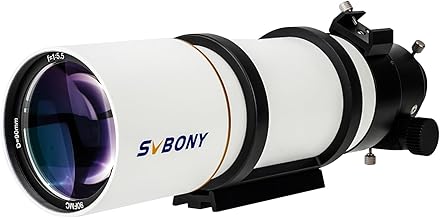
Although listed here for context, the SV48P offers a larger aperture and a broader field, which can be appealing to beginners seeking a brighter image and easier deep-sky capture. With a 90mm aperture, it provides more light input than many 80mm setups, enabling faster signal gathering and larger target visibility.
Best for: Beginners who want a straightforward upgrade path to more light and a wider field while staying within the same brand family.
Why selected: It demonstrates how a modest aperture increase can impact imaging efficiency and field coverage, useful when comparing to tighter 80mm designs.
Caution: Larger aperture adds weight and may require a sturdier mount and careful balance, especially for portable setups.
Buying Guide: Key Considerations For 80mm Refractors
What matters most when choosing an 80mm refractor for astrophotography? Consider optical design, field flatness, focuser quality, and compatibility with imaging cameras. Triplet apochromats reduce chromatic aberration and boost color fidelity, while ED glass targets sharp, contrasty images. Field flatteners and focal reducers can speed imaging but may introduce edge changes that require testing with your sensor.
Focal ratio and focal length influence exposure times and field coverage. An f/6 to f/7 class is a common middle ground, balancing wide views with reasonable magnification. A robust dual-speed focuser improves precise focusing during long exposures. Back focus distance matters for assembling cameras, reducer lenses, and flattener accessories—plan for refocusing after adding each component.
Weight and mounting compatibility affect portability and stability. A Vixen-style dovetail and a balanced counterweight setup help maintain guiding accuracy. For imaging, consider if the telescope includes or accommodates a field flattener, reducer, or dew shield to manage stray light and field curvature.
Maintenance and usability also matter. Retractable dew shields and well-designed tube assemblies reduce dew risk and stray light, supporting cleaner frames. If you travel or shoot in variable conditions, portability plus quick assembly can save time and maximize imaging opportunities.
Frequently Asked Questions
- What is the advantage of a triplet apochromatic 80mm refractor? It reduces chromatic aberration across the field, providing color-accurate, high-contrast images ideal for deep-sky targets.
- Do I need a field flattener with an 80mm ED refractor? A field flattener helps achieve edge-to-edge sharpness on larger sensors; it’s beneficial if you plan wide-field imaging.
- Is an 80mm refractor good for astrophotography beginners? Yes, especially models with good color correction and stable focusers. Pair with a suitable mount and guiding system for best results.
- What should I consider for back focus when adding accessories? Ensure the total distance between the focuser, reducer/flatteners, and camera sensor fits your telescope’s specified back focus; misalignment can ruin focus across the frame.
- How important is a dual-speed focuser? It helps achieve precise focus during long exposures, which reduces star blur and improves overall image sharpness.
- Can I use these refractors for visual observing as well? Yes, these models are suitable for both visual observing and astrophotography, though some optimizations favor imaging.
With this selection, you can compare optical design, imaging speed, and field behavior to determine which 80mm refractor best aligns with your astrophotography goals. The right balance of chromatic correction, field flatness, and focusing precision helps deliver reliable, repeatable results across deep-sky targets and planetary detail alike.