35mm and 50mm primes are among the most versatile tools in a photographer’s kit. The 35mm focal length offers a broad, contextual view suitable for street, documentary, and environmental portraits, while the 50mm provides a natural perspective with strong subject isolation in low light thanks to wide maximum apertures. This guide highlights five widely used 35mm or 50mm prime lenses across brands, focusing on performance, handling, and value. Each entry includes practical insights to help you choose the best option for your camera system and shooting style.
| Brand | Model | Focal Length | Type | Notable Strength |
|---|---|---|---|---|
| Canon | EF 50mm f/1.8 STM | 50mm | Prime | Great low-light, sharp portraits |
| Canon | AE-1 50mm Lens | 50mm | Prime | Classic film compatibility |
| Nikon | AF-S DX NIKKOR 35mm f/1.8G | 35mm | Prime | Lightweight DX format |
| Sony | FE 50mm F1.8 | 50mm | Prime | Compact, solid bokeh |
| Pentax | K1000 with 50mm Lens | 50mm | Prime | Mechanical, film-friendly |
Best Canon 50mm For Portraits

The Canon EF 50mm f/1.8 STM delivers a classic 50mm field of view with a bright f/1.8 maximum aperture, ideal for portraits, street scenes, and low-light work. It is a compact, affordable prime that remains popular with beginners and enthusiasts. Its standard 50mm perspective gives natural proportions for people and environments alike, while the lens’s 40° horizontal, 27° vertical, and 46° diagonal angles map cleanly to full-frame or cropped bodies. A minimum focusing distance of 1.15 feet (0.35 meters) and a maximum magnification of 0.21x enable easy close-up shots without extra gear.
The STM motor provides smooth, quiet autofocus for both stills and video, and the optical design maintains sharpness with minimal distortion. Weighing little more than a standard kit lens, it’s ideal for travel or daily carry. On Canon bodies, this lens pairs well with fast shooting workflows, offering reliable performance, approachable maintenance, and enduring image quality that remains competitive when compared with newer, more expensive primes.
Best Vintage Canon 50mm Lens

This listing represents a vintage Canon AE-1 50mm lens compatible with Canon FD mounts, designed for the classic 35mm SLR era. It complements the camera’s electronically controlled exposure system and focal plane shutter by providing a straightforward, standard 50mm field of view with full aperture metering and AE coupling on FD bodies. The Canon FD system, including 50mm options, is known for character and build quality that many film shooters still value today. This lens, often cited alongside Canon FD 50mm f/1.4 and f/1.8 variants, offers authentic vintage imaging with hands-on charm.
As a renewed item, the lens emphasizes manual operation and compatibility with Canon FD cameras that support full-aperture metering. Its classic rendering is often described as clean, with a bit of vintage micro-contrast that can enrich portraits and street scenes. Photographers who appreciate film-era optics frequently seek this focal length for its timeless perspective and the tactile experience of traditional manual focusing on classic bodies.
Best Nikon 35mm f/1.8G Lens

The Nikon AF-S DX NIKKOR 35mm f/1.8G offers a practical 35mm prime for DX-format bodies, giving a 52.5mm equivalent field of view in a compact package. Its 44-degree picture angle makes it versatile for street, travel, and environmental portraits. The lens features rear focusing and a manual focus override, providing precise control when you need to lock focus or adjust composition in challenging light. With an aperture range from f/1.8 to f/22, it delivers strong performance in low light while preserving sharpness across the frame.
On compatible Nikon bodies, autofocus is typically quick and reliable, delivering sharp results with minimal chasing and hunting. The light weight and solid ergonomics make it a top choice for beginners upgrading from kit lenses and for shooters who want a go-to prime that covers most everyday scenarios without adding bulk. Its price-to-performance ratio remains appealing for many standard photography tasks.
Best Sony 50mm F1.8 For Full-Frame
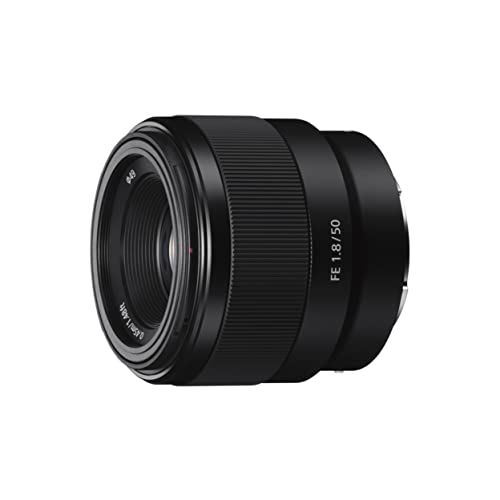
The Sony FE 50mm F1.8 standard lens balances compact size with a bright f/1.8 maximum aperture, ideal for portraits, street photography, and low-light scenes on Sony’s full-frame E-mount. A seven-blade circular aperture helps produce smooth, natural bokeh, while an aspherical element reduces spherical aberration and coma. The Double-Gauss optical design minimizes field curvature and distortion, and the metal mount adds durability. A fast DC motor focus system ensures quick autofocus across lens groups, supporting confident stills and smooth video work.
Although not the widest option in Sony’s lineup, this lens remains highly portable and affordable, making it a practical daily prime. It pairs well with Sony’s newer bodies, delivering consistent sharpness from edge to edge when stopped down, and providing a reliable standard perspective for travel, documentary, and family photography where size and weight matter as much as image quality.
Best Pentax 50mm For Film

The Pentax K1000 manual focus SLR camera with a 50mm lens exemplifies classic film photography, offering a fully mechanical body that requires no battery for basic exposure control. The standard 50mm focal length delivers a natural field of view, ideal for learning foundational techniques in composition, lighting, and depth of field. This setup emphasizes tactile control—manual aperture, shutter speed, and focus—making it an excellent educational tool and a durable workhorse for those who prefer hands-on photography on film.
While it lacks autofocus or internal metering on some variants, the K1000 remains a touchstone for students and seasoned shooters who value the purer, slower pace of film photography. Paired with a 50mm lens, it offers a timeless photography experience that highlights light, timing, and creative intent without reliance on modern automation.
Buying Guide: 35mm Or 50mm Lenses
Choosing between a 35mm or 50mm prime depends on your shooting goals, camera system, and workflow. Consider mount compatibility first: Canon EF, Nikon F, Sony E/FE, and Pentax K each have unique lens ecosystems, and some lenses may require adapters for hybrid or mirrorless bodies. If you shoot a lot of street photography or environmental portraits, a 35mm can be a comfortable wide-to-normal choice with room to tell a scene. For traditional portraits, events, and work in dim light, a 50mm with a fast aperture often yields better subject isolation and mood.
Key purchase considerations include optical quality, autofocus performance, and weight. A quiet, accurate autofocus system can matter for video or fast-paced scenes, while a manual-focus lens may suit learning-focused work and classic film or vintage camera setups. Aperture and sharpness vary across models; some 50mm primes deliver exceptional bokeh and edge-to-edge sharpness when stopped down slightly, whereas some 35mm options excel at corner performance in daylight. Budget and build quality also play into long-term value, especially with vintage or renewed lenses.
- Mount compatibility and future-proofing: ensure the lens works with your camera body or choose adapters that preserve function where possible.
- Focal length choice: 35mm for wider scenes, 50mm for natural perspective and low-light capability.
- Aperture impact: faster primes (f/1.4–f/1.8) offer better low-light performance and shallower depth of field but may cost more.
- Size, weight, and handling: lighter lenses are easier to carry; consider whether you prefer a compact travel setup or bulkier, sturdier glass.
- Autofocus vs. manual: AF is convenient for many scenarios, but MF can provide greater control on certain bodies or with vintage lenses.
- Vintage vs. modern: legacy lenses offer character and cost savings but require compatibility checks and sometimes adaptation.
- Maintenance and care: protect lenses with proper caps, keep optics clean, and use lens hoods to reduce flare.
- Resale value and support: popular brands retain value, and service options vary by maker.