Discover top 20mm wide-angle lenses across popular mounts. This guide highlights prime and versatile options that balance compact design, sharpness, and fast focusing. Whether you shoot landscapes, architecture, or street scenes, these lenses expand horizons without sacrificing image quality. The selections below cover Sony E-mount, Canon RF, Tamron’s Sony-compatible option, and Nikon F-mount, offering solid performance for both full-frame and APS-C bodies. Each entry includes key features to help you compare at a glance.
| Brand | Model | Mount / System | Max Aperture | Type |
|---|---|---|---|---|
| VILTROX | 20mm f2.8 FE | Sony E-Mount | F2.8 | Prime Wide-Angle |
| Sigma/Nikon | 10-20mm f/3.5 EX DC | Nikon DX/FX | F3.5 | Ultra Wide Zoom |
| Sony | FE 20mm F1.8 G | Sony E-Mount | F1.8 | Prime Ultra Wide |
| Canon | RF 10-20mm F4 L IS | Canon RF | F4 | Ultra Wide Zoom |
| Tamron | 20mm f/2.8 Di III OSD | Sony E / Canon RF? (depending on version) | F2.8 | Prime Wide-Angle |
The following picks emphasize broad usefulness, weight, and autofocus performance while offering a mix of constant apertures and zoom flexibility. Each product entry includes a direct, clickable link to its Amazon listing for quick comparison and purchase.
VILTROX FE 20mm f2.8

Product: VILTROX FE 20mm f2.8 for Sony E-mount. A full-frame prime that balances compact size and performance. Features include fast autofocus, near-silent operation, EXIF transmission, and USB firmware upgrades. At about 157 g, the lens is a portable option for street shoots and landscapes, delivering expansive perspective with a light footprint.
Sony FE 20mm F1.8 G
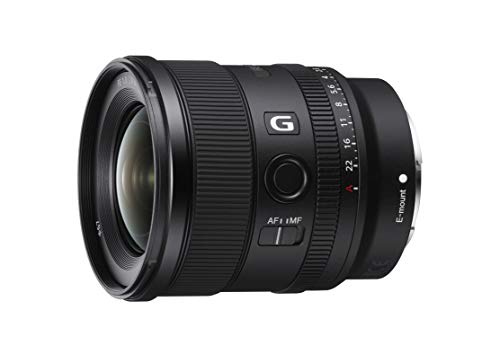
Sony’s premium 20mm F1.8 G lens offers a bright maximum aperture for shallow depth of field and strong low-light performance. It’s a compact, lightweight option designed for full-frame and APS-C cameras, delivering sharp center-to-edge performance with minimal distortion and excellent color rendition for immersive landscapes and architectural shots.
Canon RF 10-20mm F4 L IS

Canon’s RF 10-20mm F4 L IS covers a versatile zoom range with a compact form factor. It’s designed for full-frame EOS R series cameras and offers optical stabilization, a wide field of view, and a combination of Class-leading optics with aspheric elements to reduce distortion and ghosting for sharp architectural and landscape imagery.
Tamron 20mm f/2.8 Di III OSD M1:2

Tamron’s compact 20mm f/2.8 for Sony E-mount offers a macro-friendly close focus (1:2) and high image quality in a small footprint. It appeals to travel and documentary photographers who want a lightweight ultra-wide option without sacrificing detail, contrast, or color fidelity across the frame.
Nikon AF-S 20mm f/1.8G ED

Nikon’s AF-S 20mm f/1.8G ED is an FX-format prime that emphasizes ultra-wide perspective with a bright f/1.8 aperture. It features aspherical and extra-low dispersion elements to minimize aberrations, delivering sharp results with good contrast and minimal coma for night skies and architectural photography on Nikon DSLRs.
Buying Guide
Key purchase considerations for choosing a 20mm wide-angle lens include compatibility, sensor size, and mount. Full-frame lenses will exploit the widest field of view, while APS-C bodies will effectively give a tighter perspective. Aperture and weight influence low-light performance and portability. Prime lenses typically offer sharper edges and less distortion, whereas zooms provide flexibility in framing. Autofocus speed matters for moving subjects, while optical stabilization helps in low light. Build quality and weather sealing can be decisive for outdoor work. Consider your primary camera system, typical shooting conditions, and whether you prioritize maximum aperture, macro capability, or compact design.
Mount compatibility varies: Sony E-mount options emphasize compact design and fast AF; Canon RF lenses prioritize close focusing and stabilization; Nikon F-mount remains robust for wide-angle primes, though future-proofing may favor mirrorless options. If you shoot mixed systems, a versatile wide-angle zoom can supplement primes. For landscapes and architecture, edge-to-edge sharpness, distortion control, and color accuracy are essential metrics. Finally, factor in price-to-performance and ecosystem support, including future firmware updates and accessory availability.