Compact, affordable, and widely compatible, the 18-55mm zoom is a staple kit lens across Canon, Nikon, and Fujifilm. This guide compares five popular 18-55mm options to help beginners evaluate sharpness, autofocus performance, stabilization, and versatility across everyday shooting scenarios. Whether you’re traveling, capturing street scenes, or trying out video, these lenses offer flexible focal ranges for a broad range of subjects. The table below highlights the core specs to help you compare at a glance and set expectations for image quality and performance with APS-C cameras.
| Brand | Model | Notable Feature |
|---|---|---|
| Canon | EF-S 18-55mm f/3.5-5.6 II SLR Lens White Box | 16 elements in 12 groups; UD-glass and aspherical elements |
| Canon | EF-S 18-55mm f/3.5-5.6 is STM | IS up to ~4 stops; STM motor; smooth movie AF |
| Nikon | 18-55mm f/3.5-5.6G AF-S DX VR Nikkor Zoom Lens | VR; Silent Wave Motor; 27-82.5mm equivalent on DX |
| Fujifilm | XF 18-55mm f/2.8-4 R LM OIS | OIS; extra-low dispersion element; wide to short tele |
| Canon | EF-S 18-55mm f/3.5-5.6 III | Aspheric element; high-speed AF |
Canon EF-S 18-55mm f/3.5-5.6 II SLR Lens White Box

The Canon EF-S 18-55mm f/3.5-5.6 II is a classic kit lens line designed for Canon APS-C bodies. Its design emphasizes a broad zoom range suitable for everyday photography, including landscapes and street scenes. The lens features 16 elements in 12 groups, with UD-glass and aspherical elements to minimize distortion and improve sharpness across the zoom range. On Canon APS-C cameras, the diagonal angle of view spans roughly from 74°20′ at 18mm to 7°50′ at 55mm, delivering a flexible field of view for most common shooting situations. This version is noted for its reliability and compact form factor, making it a practical travel companion.
- Focal Length & Maximum Aperture: 18-55mm f/3.5-5.6 II
- Lens Construction: 16 elements in 12 groups, including UD-glass and aspherical lenses
- Diagonal Angle of View: ~74°20’–~7°50′ (APS-C)
Canon EF-S 18-55mm f/3.5-5.6 is STM Camera Lens
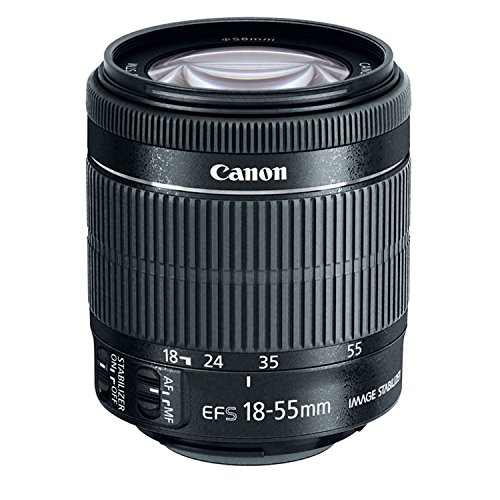
This Canon EF-S 18-55mm f/3.5-5.6 is STM is tailored for smooth autofocus in both stills and video. It has a minimum focusing distance of 0.82 ft (0.25 m) across the zoom range and provides high magnification for close-up work. The lens includes an Optical Image Stabilizer that offers up to four stops of shake correction, aiding sharp handheld photography in low light or longer focal lengths. The STM-driven motor system, combined with a six-group zoom arrangement and a dedicated stepping motor, helps deliver quiet and smooth continuous autofocus during video capture, aligning with Canon’s EOS movie workflow.
- Minimum focusing distance: 0.82 ft / 0.25 m
- Optical Image Stabilizer: up to four stops
- Movie Servo AF support with smooth continuous AF
- Six-group zoom system with a stepping motor
Nikon 18-55mm f/3.5-5.6G AF-S DX VR Nikkor Zoom Lens

The Nikon AF-S DX VR 18-55mm combines a lightweight design with Vibration Reduction (VR) and a Silent Wave Motor (SWM) for quiet, accurate autofocus. The 18-55mm range translates to roughly 27-82.5mm in 35mm terms on Nikon’s DX-format cameras, providing a versatile everyday focal length. The SWM ensures fast, smooth focusing, while VR aids image stabilization during handheld shooting, especially at longer ends of the zoom. The lens is known for dependable performance in casual photography and as a practical walkaround option for Nikon DSLRs.
- Focal Length: 18-55mm; 35mm equivalent: 27-82.5mm
- Silent Wave Motor (SWM)
- Vibration Reduction (VR) for shake reduction
- 7-blade rounded diaphragm for natural out-of-focus highlights
FUJIFILM XF 18-55mm f/2.8-4 R LM OIS Lens

The Fujifilm XF 18-55mm f/2.8-4 R LM OIS is a versatile X-mount zoom that covers a useful range for APS-C sensors, equivalent to about 27-84mm. It pairs a fast, bright aperture at the wide end with optical image stabilization for handheld shooting in varied light. The lens uses one extra-low dispersion element to reduce chromatic aberrations and color fringing, enhancing overall clarity. A linear autofocus motor (LM) enables quick and precise focusing, while the six-element optical formula and coatings help maintain contrast and minimize flare in bright conditions.
- Equivalent focal range: 27-84mm
- Optical Image Stabilization (OIS)
- One extra-low dispersion element
- Linear AF motor for fast focus
Canon EF-S 18-55mm f/3.5-5.6 III Camera Lens

The Canon EF-S 18-55mm f/3.5-5.6 III is a renewed/international model designed to be light and approachable for beginner shooters. It incorporates an aspheric lens element to improve sharpness across the zoom range and offers high-speed autofocus for quick shutter responses. The 18-55mm focal range remains a versatile option for landscapes, street photography, and casual portraits on Canon APS-C bodies. The combination of a compact footprint and reliable AF makes it a practical upgrade or backup kit lens in Canon’s ecosystem.
- Aspheric lens element
- High-speed Auto Focus
- Focal Length & Max Aperture: 18-55mm f/3.5-5.6
Buying Guide
Choosing the right 18-55mm zoom depends on camera system, intended use, and personal preferences for autofocus behavior and stabilization. Below are key purchase considerations to help you compare options across Canon, Nikon, and Fujifilm.
Compatibility and Mount Ecosystems
Each brand’s 18-55mm lenses are designed for its respective system and sensor size. Canon’s EF-S line targets Canon APS-C bodies, while Nikon’s DX-format lens is built for Nikon DSLRs. Fujifilm’s X-mount 18-55mm is intended for APS-C mirrorless bodies. If you already own a camera, confirm mount compatibility, flange distance, and electronic communication with the camera body to ensure autofocus, stabilization, and metering work correctly.
Optics and Sharpness Across Zoom
Most 18-55mm lenses incorporate aspherical elements or extra-low dispersion glass to control distortion and chromatic aberration. The presence of UD-glass or special coatings can improve contrast and mitigate flare. When evaluating sharpness, consider center versus edge performance and how it changes from wide to telephoto ends. While many of these lenses are budget-friendly, they still deliver solid results for standard photo tasks and casual video.
Autofocus Systems and Stabilization
Autofocus speed and noise vary by model and motor type. STM, SWM, and linear AF motors all influence focusing behavior in photo and video modes. Optical stabilization (IS, VR, or OIS) can dramatically improve handheld performance, particularly in low light or at longer focal lengths. If you shoot video, lenses with smoother, quieter AF systems are preferable to minimize distractions in recordings.
Build, Weight, and Handling
Kit lenses are typically compact and light, which makes travel easier. Consider a lens with a reasonable minimum focusing distance if you enjoy close-ups, or a wider focal range if you photograph landscapes. While some renewed or international models can offer savings, verify their condition and return policies. For casual shooters, a balanced combination of weight and reach can improve everyday handling and reduce fatigue during long sessions.
Use Case Scenarios
Ask yourself what you shoot most. For travel and street photography, a standard 18-55mm kit often suffices, offering flexibility across daily scenes. For beginners shooting portraits or vlogs, an image-stabilized or faster-aperture variant can be beneficial. If you anticipate heavy video work, prioritize a model with a quiet AF system and reliable stabilization. Finally, keep in mind that these lenses are often paired with smaller sensors; results reflect the sensor’s performance as much as the lens’ design.
Value, Availability, and Long-Term Usability
15-year-old kits can still deliver good results, especially for learners. Look for lenses with durable builds and consistent performance across brands, and weigh the cost of renewing to a newer option against keeping an existing kit. Availability varies by region and condition, especially for renewed or white-box editions. A well-chosen 18-55mm lens can remain a versatile workhorse as you upgrade to higher-end glass in the future.